


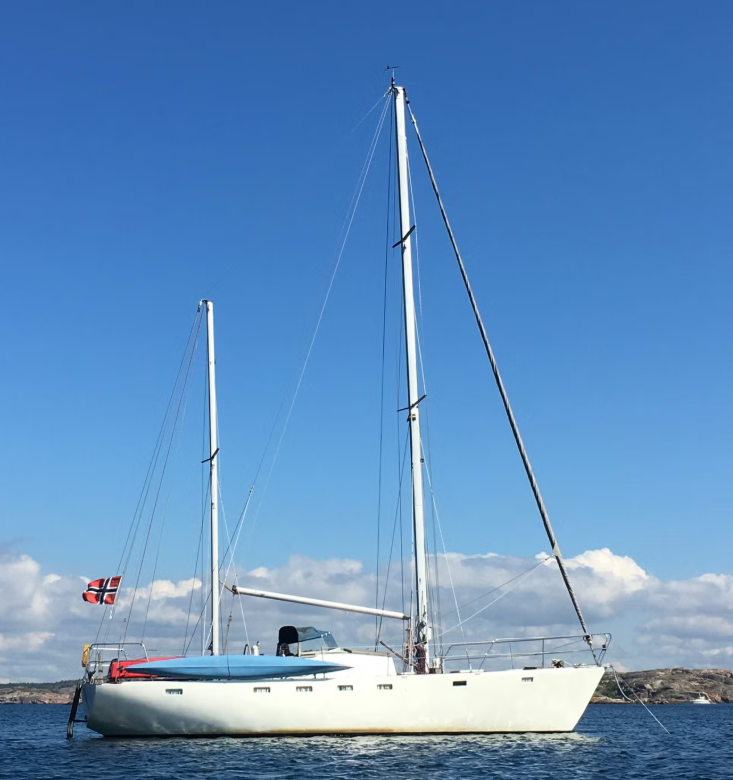
S/Y Marthine

A Norwegian-built Hartley Fijian 43 in ferro-cement

Marthine is not only the boat I am going to travel with. She is the home I live in, the project I am standing inside, and a fairly large part of the reason why this whole plan exists at all.

Marthine moored by a pier in clear weather

The boat within the project

Marthine was started in 1979 by Oddvar Juel Mathisen and Reidar Juel Mathisen after they ordered drawings for a Fijian 43 from Hartley in New Zealand. That makes her both a personal story and part of a wider tradition of large, owner-built ferro-cement offshore cruisers.

Marthine is a Hartley Fijian 43: in other words, a heavy, roomy, ocean-going type built for long-distance sailing and life aboard. I bought her in November 2025 from Reidar Juel Mathisen, who helped build her from the beginning. That changes the feel of the boat. This is not only a purchase. It is more like taking over something that has already lived a long life and trying to carry it forward properly.

Boat type Hartley Fijian 43
Origin Hartley, New Zealand
Builders Oddvar Juel Mathisen and Reidar Juel Mathisen
Build started 1979
Construction Ferro-cement over steel armature and mesh
Length 43 ft 3 in / 13.2 m
Beam 12 ft 8 in / approx. 3.86 m
Displacement Approx. 17 tons
Mast New aluminium mast installed in 2011
Propeller Brunton Autoprop installed in 2016
Role Home, workspace, and vessel for a multi-year journey

History and construction

Marthine was built from Fijian 43 drawings ordered in October 1979. According to the preserved history, construction began with the frame and 8 mm round bar, before the hull was given four layers of mesh on the outside and four on the inside before plastering. That places the boat squarely inside the classic ferro-cement tradition.

What kind of boat this really is

The Hartley Fijian 43 is not a light, twitchy boat built to impress with speed figures. This is a big, steady, capable long-distance cruiser with volume, carrying capacity, and a good deal of liveaboard quality. That is exactly why she makes sense for me. I do not need a racer. I need a boat that can be both home and vessel.

Ferro-cement without myths and odd ideas

Ferro-cement does not mean the boat is a floating block of concrete. It is a relatively thin cement shell reinforced with steel and several layers of mesh. In the 1970s and 1980s this was a real way of building large boats yourself, without everything having to go through a yard and a large budget. Marthine is therefore not a strange side track, but a good example of a distinct boatbuilding culture.

A boat that has genuinely been used

What is good about the history is that it is not only about building, but about use. There are traces of early trips in the Oslofjord, weather-bound days at Misingen, haul-outs in Sandefjord, a voyage to France in 1988, and later upgrades like a new aluminium mast and a Brunton Autoprop. That makes the boat feel more alive. She has not only existed. She has been out there doing the job.

Buying into a story

I did not only buy a hull and a pile of systems. I bought into a story with clear traces of work, pride, use, wear, and interrupted plans. That changes the responsibility too. My project is not only about getting away. It is also about giving an old boat a real new chapter instead of just good intentions.

The starting point now

The last years before the change of ownership were marked by engine work, deck work, and a serious accident in which a seawater hose came off and left the engine under water for several hours. That means I am not starting from a blank sheet. I am starting with a boat that needs time, money, judgement, and a fairly thorough review. That is part of the challenge, and much of the motivation.